

By Dr. Eduardo Nunes
Brazilian board-certified plastic surgeon
The key idea: a breast implant is not simply a device that makes the breast larger. In the right patient, it can also help create a rounder outline, restore fullness in the upper breast, improve projection and make the breast keep its shape more consistently without a bra. |
When many people think about breast implants, they think only about breast enlargement. That is understandable. Women with naturally small breasts, a condition often called breast hypoplasia, commonly seek surgery because they want more volume.
But size is only one part of breast appearance. Two women may have breasts of a similar size and still have very different concerns. One may have small but firm breasts and simply want them larger. Another may have loose skin, little fullness in the upper part of the breast and a nipple that sits too low. A third may be satisfied with her overall size but want a rounder shape, more projection or a more defined neckline.
For this reason, a modern breast consultation should not begin with a discussion about a specific number of cubic centimeters. It should begin with a simple question: what exactly does the patient want to change?
Breast appearance depends on several factors working together. These include the amount of breast tissue, the amount of fat, the quality of the skin, the position of the nipple, the width of the chest, the natural space between the breasts and the position of the fold under the breast.
This explains why the same implant can look very different in two patients. An implant that looks proportional in a woman with a wider chest may be too wide for a woman with a narrow chest. A high-projection implant may create an attractive result in one patient but place too much pressure on the tissues of another.
Good planning therefore matches the implant to the patient’s anatomy. Width, height, projection, gel firmness and the quality of the patient’s tissues can be just as important as implant volume. This approach is often called tissue-based planning. [1,2]
A natural breast is not a fixed structure. It is made of glandular tissue, fat, skin and supporting fibers. It changes shape when a woman stands, lies down, bends forward or moves. Soft breasts may spread toward the sides of the chest when the patient lies on her back. The cleavage created by a push-up bra may disappear as soon as the bra is removed.
This movement is normal. It is also one of the reasons some women seek implants even when they do not want a major increase in size. They may want a breast that keeps a more consistent shape in a dress, bikini or swimsuit, and that moves less from side to side when they lie down.
An implant can add an internal structure that helps maintain projection and fill an empty skin envelope. It can make the breast more stable, but it does not make the breast completely rigid or immobile. The goal should be improved shape control while preserving a natural appearance and feel.
The upper pole is the area of the breast above the nipple. Many natural breasts have little fullness in this area, especially after pregnancy, breastfeeding, weight loss or aging. The breast may have enough tissue overall, but most of that tissue sits in the lower part of the breast.
A patient may describe this as an “empty” upper breast. She may obtain the shape she likes only by wearing a padded or push-up bra. In this situation, an implant can help restore volume where it is missing and create a smoother, fuller line from the upper chest to the nipple.
Not every woman wants the same upper-pole shape. Some prefer a soft, gentle slope that looks very natural. Others want a clearly rounder upper breast that remains visible in low-cut clothing. Neither preference is automatically right or wrong. The important point is that the surgeon and patient must agree on the desired shape before surgery. Studies show that patients and surgeons do not always imagine the same “ideal” breast. [3]
Cleavage is another common request. Many patients want the breasts to look closer together and create a more defined line in the center of the chest.
An implant may increase fullness on the inner side of the breast, but cleavage is not controlled by implant size alone. It also depends on the width of the breastbone, the natural distance between the breasts, the position of the chest muscles, the amount of tissue covering the implant and the width of the implant itself.
A patient with naturally wide-set breasts may achieve better medial fullness, but it may not be safe or realistic to make the breasts touch without a bra. Creating an implant pocket too close to the center of the chest can damage the normal separation between the breasts and cause a difficult complication called symmastia, sometimes described as a “uniboob.” Safe surgery respects the patient’s natural chest anatomy.
Some women believe that their breasts are simply too small, but the main problem is actually breast sagging, or ptosis. A sagging breast may contain a reasonable amount of tissue, but the tissue sits too low inside a loose skin envelope. This can make the upper breast look empty and the entire breast look smaller than it really is.
In these cases, using a large implant alone is usually not the best solution. An implant can fill some of the loose skin, but it does not reliably lift a nipple that is too low or remove excess skin. A heavy implant may also stretch weak tissues even more over time.
A breast lift, known medically as mastopexy, removes or adjusts excess skin, reshapes the existing breast tissue and raises the nipple when necessary. [4] The decision is therefore not simply “implant or no implant.” The surgeon must decide whether the patient needs more volume, a tighter skin envelope, redistribution of her own tissue, or a combination of these changes.
An implant alone may be suitable when the nipple is in a good position, there is little excess skin and the main goal is greater volume, projection or upper-pole fullness. It can also improve very mild drooping in carefully selected patients, but it cannot replace a true breast lift when the nipple is clearly low.
A breast lift alone may be the best choice when the patient already has enough breast tissue and mainly wants to correct sagging. The surgeon can reshape and reposition the patient’s own tissue. This can produce an attractive and natural breast without a prosthesis.
However, a lift without an implant may not create the same degree of round upper-pole fullness that an implant can provide, especially when the patient has very little tissue in the upper breast. The patient must understand this difference before choosing the operation.
When a patient has both sagging and lack of fullness, a lift and an implant may be combined. The lift controls the excess skin and nipple position. The implant helps control projection, upper-pole fullness and the overall outline of the breast.
The implant does not always need to be large. In many patients, a small or moderate implant is used mainly to improve shape. Some women can even maintain a similar overall breast size after surgery: excess skin and, in selected cases, some breast tissue are removed, while a carefully chosen implant creates a rounder and more predictable contour.
This combined surgery is more complex than either operation alone because the lift tightens the skin while the implant adds volume inside it. Careful planning is essential. A systematic review of 4,856 cases found that the operation can be performed with acceptable complication and reoperation rates in properly selected patients, but results varied among studies and techniques. [5]
Breast implants are available in different shapes. The two broad categories are round implants and anatomical, or teardrop-shaped, implants.
Round implants are symmetrical. They may create a soft and natural result or a more visibly round upper breast, depending on their width, profile, gel and position. Because their shape is the same in every direction, rotation usually does not change the appearance of the breast in the way it can with an anatomical implant.
Anatomical implants have a defined top and bottom, with more volume in the lower part. They can be useful when the surgeon wants specific control of breast height, lower-pole shape or projection. Because they have a fixed orientation, rotation may visibly distort the breast shape.
It is incorrect to say that round implants always look artificial or that anatomical implants always look natural. Research has not shown that one shape is more attractive in every patient. The result depends on the implant dimensions, the patient’s tissues and the surgical technique. [6,7]
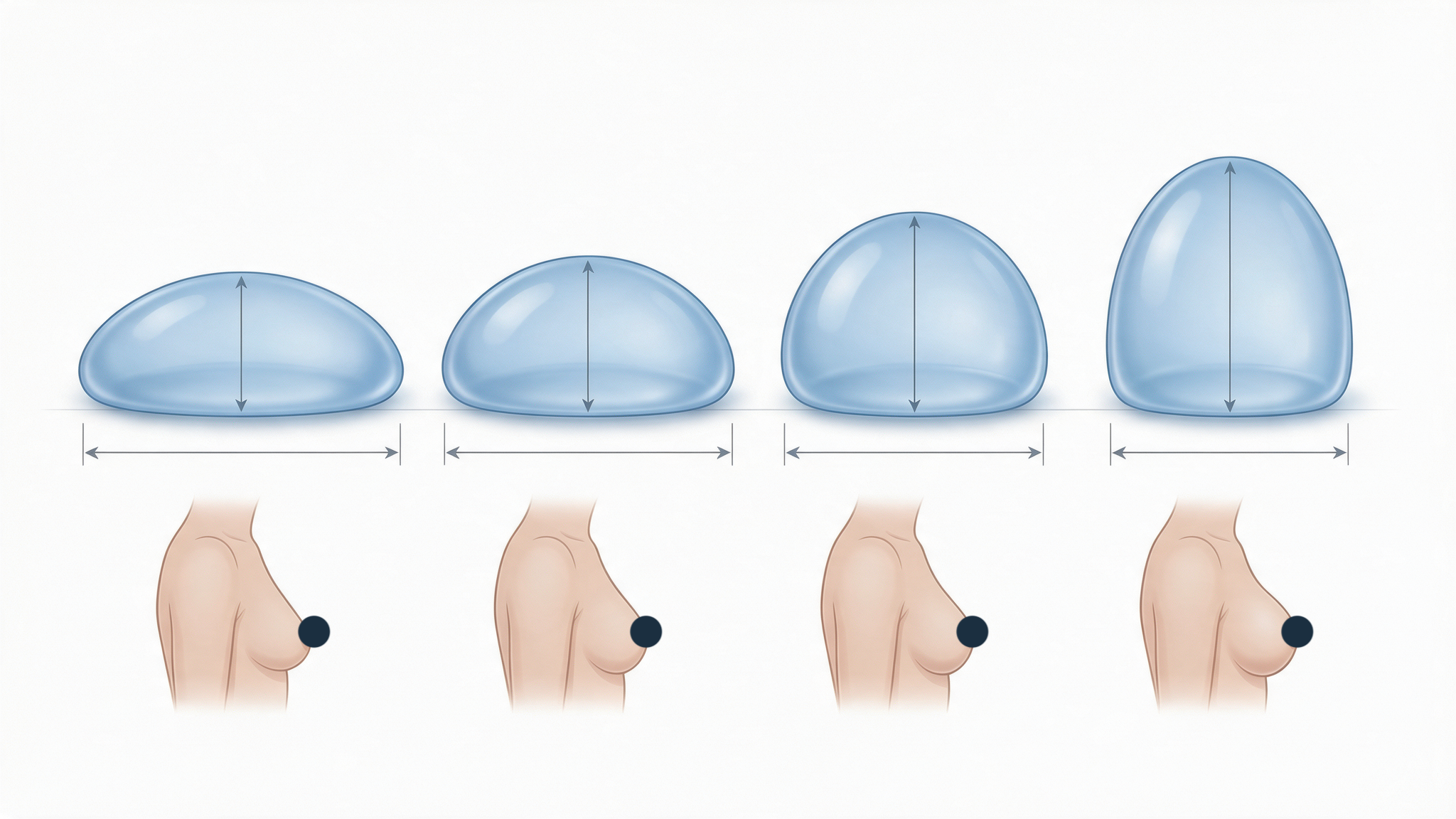
Two implants can contain the same volume and still create very different results. A wider implant spreads its volume across a larger area of the chest. A narrower implant with greater projection places more volume forward.
This is why choosing an implant only by volume can be misleading. The surgeon should also consider:
More cohesive gels tend to keep their shape and projection more strongly. Softer gels may move more naturally with the body. Neither option is ideal for every patient. The choice involves balancing shape control, softness, tissue coverage and the patient’s expectations.
The implant may be placed above the chest muscle, below the breast fascia, partly below the muscle or in another carefully chosen tissue plane. The best option depends on the thickness of the tissues, the patient’s anatomy, the implant and the surgeon’s plan.
The pocket is the space created to hold the implant. Its size and position are extremely important. If it is too wide or extends too far toward the side of the chest, the implant may move excessively when the patient lies down. If it is too small or poorly positioned, the breast can look distorted.
A large implant placed inside weak tissues may stretch the skin and supporting structures over time. For a patient whose main goal is shape rather than major enlargement, a moderate implant is often more sensible and more respectful of the tissues.
Fat grafting uses fat removed from another area of the patient’s body and transfers it to the breast. It is useful for modest enlargement, correction of small differences between the breasts and improvement of specific areas, such as the inner breast or upper pole.
Fat is soft, natural tissue, but it does not behave exactly like an implant. Some of the transferred fat is absorbed, and the remaining fat can change with weight gain or weight loss. In a patient with very loose skin or very little breast tissue, fat alone may not provide the same projection or shape stability as an implant.
In hybrid breast augmentation, a smaller implant provides the main structure while fat grafting improves coverage and smooths the edges. This combination can be useful in selected patients.
A stable breast should not be confused with a hard breast. The desired result is a breast that keeps its shape reasonably well while remaining soft and natural to the touch.
Abnormal firmness can be a sign of capsular contracture, a complication in which the scar tissue around the implant tightens. A well-planned breast implant should support the desired shape without overpowering the patient’s tissues.
No operation can permanently stop aging, gravity, pregnancy or weight changes. Breasts continue to change after surgery. Larger and heavier implants place greater long-term stress on the tissues, which is another reason to avoid choosing size without considering anatomy.
Breast implants are medical devices, and they are not lifetime devices. The longer a patient has implants, the greater the chance that she may eventually need another operation. [8,9]
Possible problems include:
Patients should also receive clear information about rare conditions linked to breast implants, including breast implant-associated anaplastic large cell lymphoma, known as BIA-ALCL. This condition has been associated more often with certain textured implant surfaces. The availability and approval of implant types vary between countries, so the discussion must be based on the devices currently available in the patient’s location. [9]
Good care includes keeping the implant identification card, attending regular clinical follow-up and completing imaging when recommended. Surgery should be chosen only after a complete discussion of benefits, limitations, alternatives and future responsibilities.
The best breast surgery plan begins with diagnosis, not with implant size. The surgeon should identify whether the main issue is lack of volume, loose skin, low nipple position, empty upper pole, wide breast spacing, weak tissues or a combination of these factors.
Only after this analysis should the implant be selected. Its width, height, projection, shape and gel must fit both the patient’s anatomy and the appearance she wants.
Breast implants are often used to make breasts larger. But they can also be used to create a different shape, restore upper-pole fullness, improve projection, help the breast maintain its contour and complement a breast lift. In some patients, these shaping functions are more important than the increase in volume itself.
The goal is not simply a larger breast. The goal is a breast whose size, shape, position, movement and proportions are appropriate for the patient’s body and expectations. |
Selected References
1. Tebbetts JB. A system for breast implant selection based on patient tissue characteristics and implant-soft tissue dynamics. Plastic and Reconstructive Surgery. 2002;109(4):1396-1409. Access online
2. Adams WP Jr, Mckee D. Matching the implant to the breast: a systematic review of implant size selection systems for breast augmentation. Plastic and Reconstructive Surgery. 2016. Access online
3. Hsia HC, Thomson JG. Differences in breast shape preferences between plastic surgeons and patients seeking breast augmentation. Plastic and Reconstructive Surgery. 2003;112(1):312-320. Access online
4. Hidalgo DA. Mastopexy. Plastic and Reconstructive Surgery. 2013;132(4):642e-656e. Access online
5. Khavanin N, et al. A systematic review of single-stage augmentation-mastopexy. Plastic and Reconstructive Surgery. 2014;134(5):922-931. Access online
6. Cheng F, et al. Round versus anatomical implants in primary cosmetic breast augmentation: a meta-analysis and systematic review. Plastic and Reconstructive Surgery. 2019;143(3):711-721. Access online
7. Hidalgo DA, Weinstein AL. Intraoperative comparison of anatomical versus round implants in breast augmentation: a randomized controlled trial. Plastic and Reconstructive Surgery. 2017;139(3):587-596. Access online
8. U.S. Food and Drug Administration. What to Know About Breast Implants. Updated January 31, 2025. Access online
9. U.S. Food and Drug Administration. Risks and Complications of Breast Implants. Access online

World-Class Aesthetic Surgery
& Longevity Centre
in Bali's Luxury Destination.