
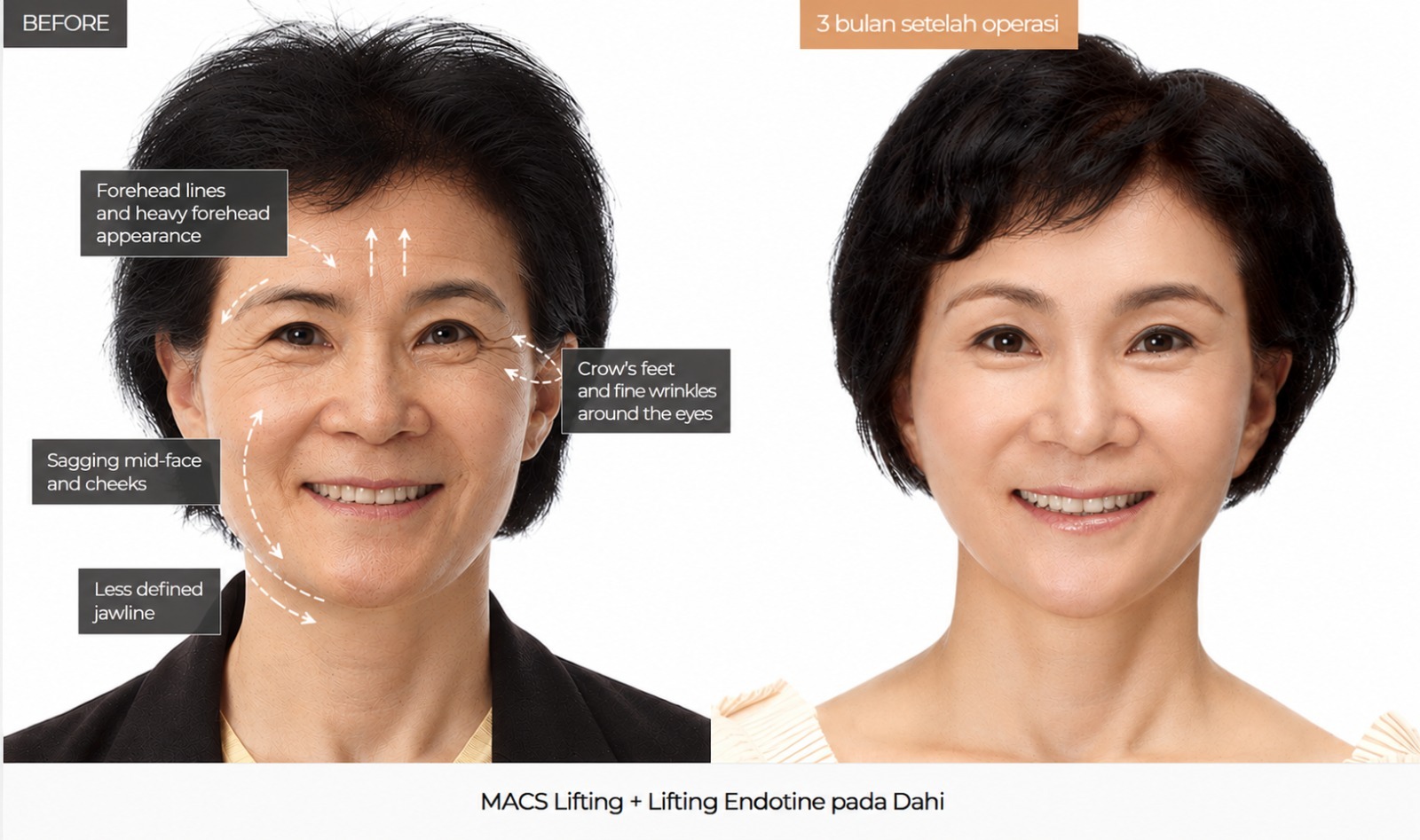
Facial aging is a gradual process that affects different areas of the face in different ways. Over time, changes in skin elasticity, the position of underlying soft tissues, and the distribution of facial volume can contribute to sagging skin, deeper facial folds, a less defined jawline, and changes around the eyebrows and forehead.
Although these changes are a natural part of aging, their appearance varies from person to person. Some individuals are primarily concerned about sagging cheeks and jowls, while others notice that their eyebrows have descended, their forehead wrinkles have become more pronounced, or their upper eyelids appear heavier than before.
Because facial aging does not affect every area equally, facial rejuvenation should not be approached as a single procedure that addresses all concerns in the same way. Different lifting techniques are designed to target different anatomical regions, and the most appropriate option depends on an individual’s facial structure, degree of tissue laxity, medical history, and aesthetic goals.
At Banobagi Plastic Surgery in Seoul, South Korea, facial rejuvenation options include procedures designed for different areas of the face. Among the techniques worth understanding are the MACS Lift, which focuses on sagging in the lower face, and the Endotine Forehead Lift, which addresses concerns involving the forehead and brow area. Although both are lifting procedures, they target different areas and are designed to address different signs of facial aging.
Although both procedures belong to the broader category of facial lifting surgery, they serve different purposes. Understanding their differences can help individuals prepare for a more informed consultation and better understand which concerns each procedure may address.
MACS stands for Minimal Access Cranial Suspension. A MACS Lift is a type of facelift technique developed to address facial tissue descent through a comparatively limited surgical access approach.
The procedure focuses on lifting and repositioning sagging tissues in the lower face to improve facial contours. The surgical approach is tailored to the patient’s anatomy, the degree of tissue laxity, and the desired outcome. A thorough consultation helps determine whether a MACS Lift is appropriate for the individual’s concerns.
As facial tissues descend, the cheeks may appear less lifted, the contours around the mouth may become more pronounced, and the jawline may lose some of its definition. In some individuals, the development of jowls contributes to a heavier appearance in the lower face.
A MACS Lift is designed to address selected signs of these changes by repositioning underlying soft tissues rather than relying exclusively on pulling the skin tighter. The surgical approach generally uses incisions around the ears and suspension sutures to support the repositioned tissues. The precise technique, incision placement, and extent of correction depend on the surgeon’s assessment.
One reason patients may wish to learn about this procedure is that it offers an alternative to consider when discussing facial lifting options. However, the term “minimal access” should not be interpreted as meaning that the procedure is nonsurgical, risk-free, or suitable for everyone.
A MACS Lift remains a surgical procedure that requires appropriate planning, anesthesia, postoperative care, and recovery. Its suitability depends on factors such as the distribution of facial sagging, skin quality, tissue characteristics, and the patient’s expectations.
The primary objective of a facelift is to improve selected signs of facial tissue descent. For suitable candidates, a MACS Lift may be considered when concerns involve sagging around the cheeks, jowls, and lower facial contours.
As the supporting tissues of the face change with age, the transition between the cheeks and lower face can become less defined. The jawline may appear softer, and tissue descent may make the face look heavier than the individual expects.
By repositioning selected soft tissues, a facelift may improve these contours and create a more refreshed appearance. However, the degree of improvement depends on the patient’s anatomy and the surgical technique used.
It is also important to distinguish between sagging tissue and loss of facial volume. A lifting procedure primarily addresses tissue position; it does not automatically restore volume that has diminished with age. Patients with significant volume loss or changes in skin quality may need to discuss additional options with their surgeon, if appropriate.
Similarly, not every facial concern can be corrected through a MACS Lift alone. Forehead wrinkles, descended eyebrows, upper eyelid concerns, and neck laxity may require separate evaluation. A comprehensive assessment helps determine which areas are likely to benefit from a particular procedure and which may need a different approach.
The goal of consultation is therefore not simply to select a procedure by name, but to identify the anatomical changes that contribute to the patient’s concerns.
While a MACS Lift primarily addresses selected areas of facial sagging, an Endotine Forehead Lift focuses on the upper face, particularly the forehead and eyebrow region.
Banobagi describes its Forehead Endotine procedure as an option for concerns such as forehead lines, frown lines, and drooping eyelids associated with descending forehead tissues. The clinic’s published information explains that the procedure involves several small incisions behind the hairline, through which the forehead tissues can be lifted and repositioned.
During the procedure, the surgeon uses an endoscopic approach to assist with visualization and tissue dissection while monitoring the locations of important nerves and blood vessels. An Endotine fixation device is then used to help secure the lifted tissues in their new position.
The purpose of the lift is to improve selected signs of upper-face descent. Depending on the individual’s condition, this may include a lowered brow position, forehead wrinkles associated with tissue descent, and an upper eyelid appearance affected by the position of the forehead and eyebrows.
The Endotine device is a fixation system used to distribute support across multiple contact points rather than relying solely on a single point of fixation. Its role is to help maintain the repositioned tissue during healing.
However, the procedure should not be understood as a universal solution for every type of forehead wrinkle or drooping eyelid. Wrinkles may arise from several factors, including repeated muscle movement, skin changes, and tissue descent. Likewise, heavy upper eyelids can have different underlying causes.
A clinical examination is necessary to determine whether forehead lifting, eyelid surgery, or another approach is more appropriate for the individual’s concerns.
Several procedures can affect the appearance of the eyebrows and upper eyelids, but they do not address exactly the same anatomical structures.
A forehead lift repositions the forehead and brow tissues. It may be considered when the position of the eyebrows contributes to a heavy appearance around the eyes or when forehead tissue descent is associated with visible lines.
Upper blepharoplasty, by comparison, focuses on the upper eyelids and may involve removing excess skin or addressing other eyelid tissues, depending on the surgical plan. Browpexy is another technique that supports or elevates the brow through a different surgical approach.
These procedures are not interchangeable. An individual whose main concern is excess upper eyelid skin may require a different assessment from someone whose eyebrows have descended significantly.
In some cases, more than one anatomical factor contributes to the appearance of the upper face. The surgeon must therefore evaluate the position of the eyebrows, the amount of upper eyelid skin, forehead movement, and the patient’s overall facial proportions before recommending treatment.
Banobagi’s published information on Forehead Endotine also emphasizes individualized surgical planning. The final treatment plan and cost are determined after an in-person examination.
Although both procedures aim to improve signs of aging, their primary treatment areas and surgical objectives differ.
A MACS Lift primarily targets sagging in the lower face, particularly concerns involving jowls and reduced jawline definition. In contrast, an Endotine Forehead Lift focuses on repositioning the forehead and brow tissues. Understanding these differences can help patients discuss their concerns and treatment goals more clearly during a consultation.
An Endotine Forehead Lift, on the other hand, focuses on the upper face. It may be considered when a descended forehead or brow contributes to forehead lines, frown lines, or a heavy upper eyelid appearance.
The distinction is important because facial aging is not uniform. A patient may have pronounced sagging around the jawline while maintaining a relatively elevated brow position. Another patient may have significant brow descent but little concern about the lower face.
Neither procedure is automatically better than the other. They are intended to address different anatomical concerns, and the appropriate choice depends on the condition being treated.
In certain circumstances, a surgeon may discuss more than one procedure if several areas require attention. However, combining procedures is not necessary for everyone and should only be considered when supported by an individualized medical assessment.
The aim is to select a treatment strategy that corresponds to the patient’s anatomy and priorities rather than choosing a procedure simply because it is popular or commonly associated with facial rejuvenation.
One of the most important steps in facial rejuvenation is determining which anatomical changes are responsible for a patient’s concerns.
For example, a less defined jawline may result from tissue descent, changes in skin elasticity, fat distribution, or a combination of factors. Similarly, a tired-looking eye area may be influenced by brow position, excess eyelid skin, or other anatomical characteristics.
Treating the visible symptom without understanding its underlying cause may lead to a mismatch between the procedure and the patient’s expectations.
A thorough consultation should therefore include an assessment of the relevant facial structures, discussion of previous cosmetic procedures, review of medical history, and consideration of the patient’s desired outcome.
The surgeon should also explain the limitations of the recommended procedure, potential risks, expected recovery, and whether alternative approaches may be more appropriate.
Patients should feel comfortable asking which anatomical structures will be addressed, why a particular technique is being recommended, and what changes are realistic to expect.
It is equally important to discuss whether the proposed treatment is likely to address the patient’s main concern or whether some features may remain unchanged. Clear communication supports more realistic expectations and a better-informed decision-making process.
Both the MACS Lift and Endotine Forehead Lift are surgical procedures, and recovery varies according to the technique, the extent of surgery, and individual healing characteristics.
Following facial lifting surgery, patients may experience swelling, bruising, temporary discomfort, and changes in sensation. Incision care and follow-up appointments are important parts of postoperative management.
For its Endotine Forehead Lift, Banobagi publishes an approximate operation time of one hour to one hour and thirty minutes, with sedation anesthesia, same-day discharge, and a stated possibility of resuming daily activities within seven days. The clinic also notes that stitches are removed after approximately ten days. These are general estimates provided by the clinic, not guarantees for every patient.
Recovery after a MACS Lift may differ according to the extent of correction and whether other procedures are performed at the same time. Patients should obtain procedure-specific instructions directly from their surgeon rather than assuming that the recovery schedule for one lifting technique applies to another.
Potential surgical complications can include bleeding, infection, inflammation, scarring, and other procedure-specific risks. Individual outcomes and satisfaction may also vary.
Before surgery, patients should discuss their medical history, medications, previous procedures, and any factors that may affect healing. They should also clarify the recommended duration of follow-up and what to do if unexpected symptoms occur during recovery.
For patients traveling internationally for surgery, planning should include sufficient time for postoperative assessment and clear arrangements for follow-up after returning home.
Choosing a facial lifting procedure begins with understanding which areas of the face are changing and what the patient hopes to improve.
For individuals concerned about jowls, lower-face sagging, or changes in jawline definition, a MACS Lift may be one option to discuss with a qualified plastic surgeon. For those whose concerns involve a descended brow or forehead tissues, an Endotine Forehead Lift may be relevant to the consultation.
The two procedures serve different purposes, and neither should be selected based on age alone, a trend on social media, or the assumption that one technique is suitable for everyone.
At Banobagi Plastic Surgery, patients can explore available facial rejuvenation options and discuss their concerns with the medical team. An individualized evaluation helps determine which procedure, if any, is appropriate for the patient’s anatomy and goals.
Ultimately, effective treatment planning involves more than choosing a surgical name. It requires an understanding of facial anatomy, realistic expectations, careful consideration of risks, and a clear postoperative plan.
By learning about the differences between the MACS Lift and Endotine Forehead Lift, patients can approach their consultation with a better understanding of the available options and more focused questions about their individual needs.
Medical disclaimer: This article is intended for general educational purposes and does not replace an in-person medical consultation. The suitability, risks, expected outcomes, and recovery associated with any surgical procedure must be assessed individually by a qualified medical professional.
Related content: Explore the Instagram Reel discussing MACS Lift and Endotine Forehead Lift for additional context on these facial rejuvenation procedures.

World-Class Aesthetic Surgery
& Longevity Centre
in Bali's Luxury Destination.