

BY DR. EDUARDO NUNES
Brazilian board-certified plastic surgeon | Advanced body contouring specialist
When RealSelf identified rib remodeling as one of the most discussed aesthetic surgery topics of 2026, it confirmed a movement that had already been gaining momentum within advanced body-contouring surgery.
Until recently, aesthetic operations involving the ribs were regarded as unusual, controversial and restricted to a relatively small group of surgeons. Today, rib remodeling has become part of the international conversation about waist definition, high-definition liposculpture and structural body contouring.
The reason for this growing interest is understandable.
Modern plastic surgery has become extremely effective at treating the soft tissues of the torso. Surgeons can remove fat selectively, reveal muscular anatomy, repair abdominal wall laxity, improve skin contraction and redistribute volume to produce a more harmonious relationship between the waist and hips.
However, these treatments do not change the underlying skeleton.
In certain patients, the width, angulation or lateral projection of the lower rib cage remains the principal anatomical limitation to achieving a more defined waist. Even an excellent liposuction or abdominoplasty result may be restricted by an unfavorable thoracic framework.
Rib remodeling emerged as a possible solution to this structural limitation.
Its objective is not simply to make the waist smaller. The real purpose is to modify the relationship between the lower thorax, waist and pelvis while preserving a natural and proportional silhouette.
This is why rib remodeling should not be dismissed as a temporary social-media trend. It represents a genuine expansion of what can be treated through body-contouring surgery.
At the same time, it must not be presented as a minor or superficial procedure. Rib remodeling involves the thoracic skeleton and is performed close to the pleura, lungs, intercostal structures, diaphragm and abdominal organs. Its development is important, but its adoption must be accompanied by appropriate training, careful patient selection and the same clinical discipline expected from any major surgical procedure.
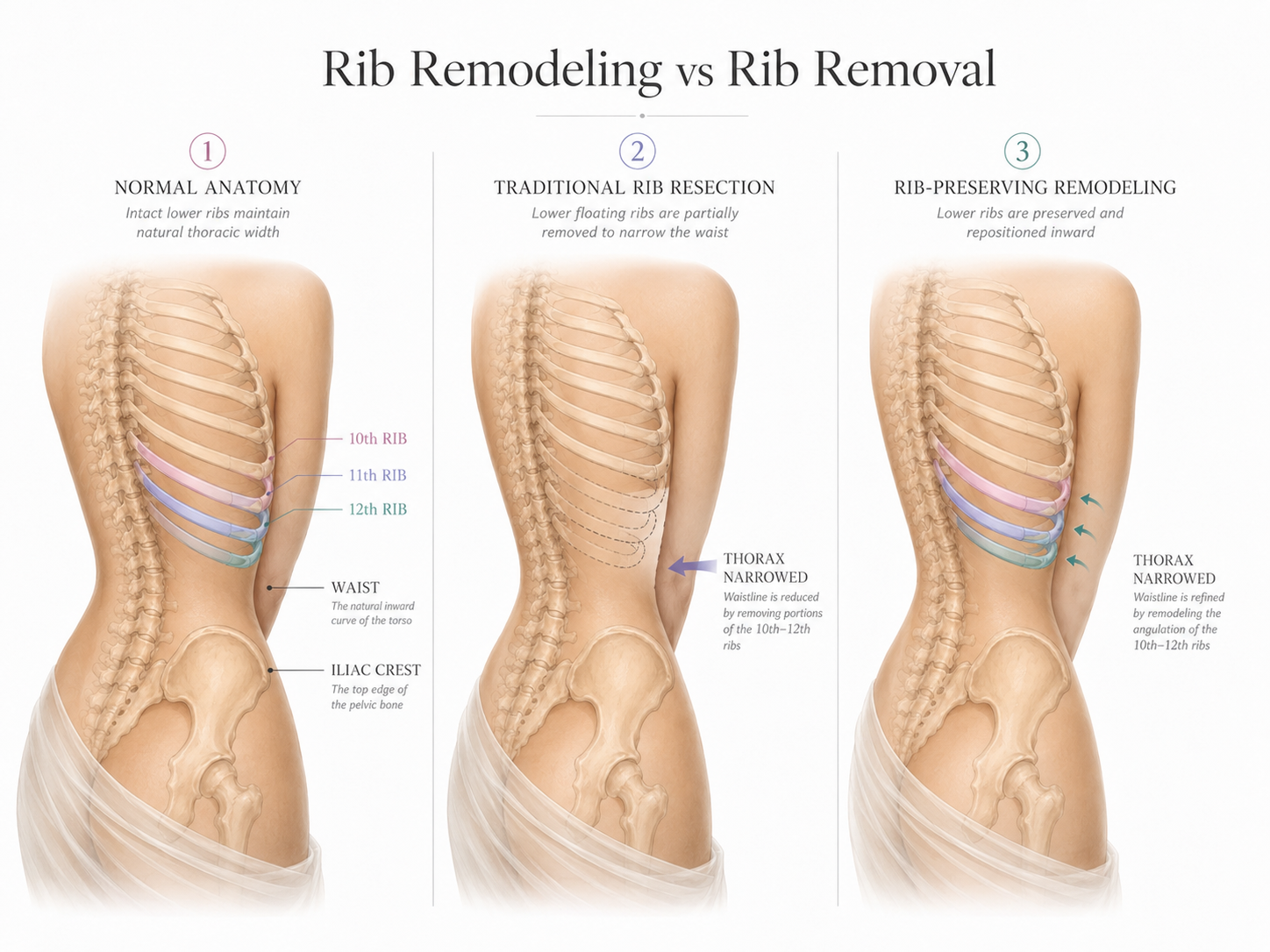
One of the most important distinctions for patients and surgeons is the difference between rib remodeling and rib resection.
Traditional aesthetic rib-reduction surgery usually involved the partial or complete removal of the floating ribs, most commonly the 11th and 12th ribs. Although resection may reduce the width of the lower thorax, it is a more invasive procedure and permanently removes part of the patient’s natural skeletal structure.
Modern rib remodeling generally preserves the ribs.
Instead of removing them, the surgeon creates a controlled corticotomy, osteotomy or incomplete fracture. The lower ribs are then repositioned toward a more favorable angle and allowed to consolidate in their new configuration.
Depending on the technique, the new position may be maintained through external compression, internal fixation or a combination of both.
It is also important to understand that rib remodeling is not one standardized procedure. The term describes a family of operations that may differ significantly.
The principal technical variations include:
A smaller incision does not automatically mean that a technique is safer. Similarly, a larger incision does not necessarily mean that the operation is more aggressive.
Safety depends on anatomical control, visualization, the direction of instrument advancement, surgical experience and the ability to recognize and manage complications.
A narrow waist is not determined by waist circumference alone.
The visual perception of an hourglass figure depends on the relationship among the shoulders, lower thorax, waist, pelvis and hips. It is a three-dimensional transition rather than a single measurement.
One patient may have poor waist definition because of excess subcutaneous fat. Another may have rectus diastasis or abdominal wall laxity. A third may have loose skin following pregnancy or substantial weight loss.
In other patients, however, the main limitation is the width or lateral projection of the lower rib cage.
The surgeon must identify the real anatomical cause before recommending treatment.
The principal factors that may limit waist definition include:
Rib remodeling is relevant only when the skeletal component contributes meaningfully to the patient’s body shape.
It cannot correct excessive visceral fat, untreated abdominal wall laxity or poor skin quality. It should not be used as a substitute for appropriately performed liposuction, abdominoplasty or fat grafting.
The operation must be based on a complete anatomical diagnosis.
The modern development of rib remodeling cannot be attributed to one surgeon alone.
The field evolved through different approaches to preserving, mobilizing and stabilizing the lower ribs. Nevertheless, a small number of surgeons have played particularly important roles in its development.
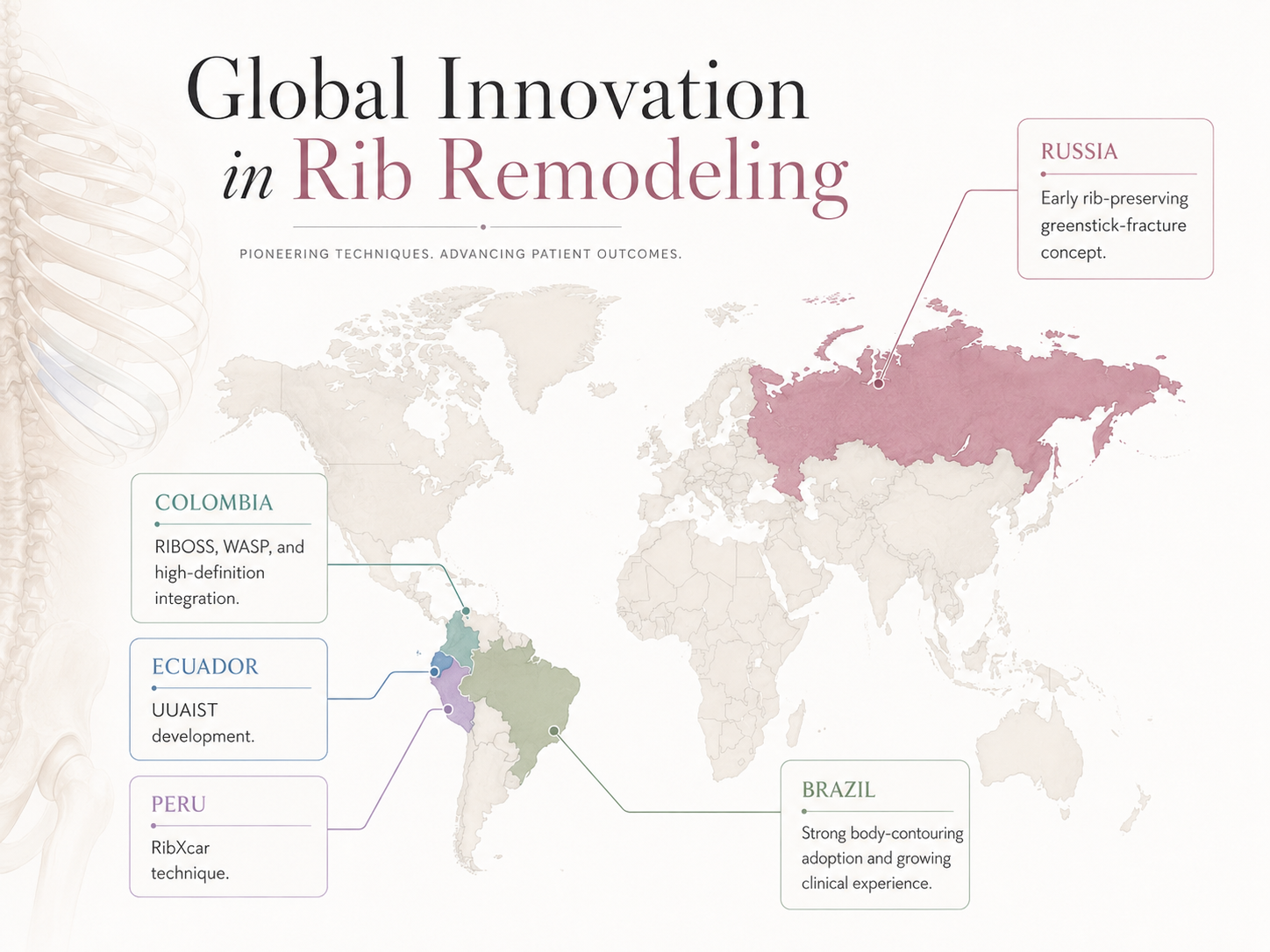
Russian surgeon Dr. Kazbek Kudzaev is widely regarded as one of the earliest pioneers of modern rib-preserving waist surgery.
His work helped establish the concept of producing controlled greenstick fractures in the floating ribs and maintaining their new position through external compression.
This represented an important departure from traditional rib-removal surgery.
Instead of removing the ribs, the objective became to preserve them while modifying their projection and angulation.
Kudzaev’s work provided much of the conceptual foundation upon which later minimally invasive costal-remodeling techniques were developed. Russia consequently became one of the earliest centers of significant experience in this field.
Peruvian plastic surgeon Dr. Raúl Manzaneda Cipriani became one of the most internationally recognized names in rib remodeling through the development of the RibXcar technique.
RibXcar uses limited puncture access, ultrasound guidance and piezoelectric instruments to create controlled corticotomies or incomplete fractures of the lower ribs.
The technique gained rapid visibility because it proposed skeletal remodeling without rib removal and without a conventional surgical incision.
Its influence extended throughout Latin America and contributed significantly to the international popularization of rib remodeling.
RibXcar also stimulated important discussion regarding the use of real-time imaging, the learning curve, instrument trajectory and the need for precise anatomical control when operating close to the pleura and abdominal cavity.
Ecuadorian surgeons Dr. Carlos Oñate Valdivieso and Dr. Daniel Oñate Valdivieso played an important role in developing ultrasound- and ultrasonic-assisted approaches to costal remodeling.
Their work with UUAIST helped formalize the use of real-time ultrasound and piezoelectric bone treatment during thoracic indentation procedures.
Their contribution is especially relevant because it integrated rib remodeling into the broader philosophy of high-definition body contouring.
The ribs were no longer considered an isolated structure. They became part of the complete anatomical transition between the thorax, waist and hips.
Colombian plastic surgeon Dr. Hugo Aguilar Villa is closely associated with the development of RIBOSS, an approach based on rib osteotomy combined with internal stabilization.
Unlike techniques that depend predominantly on an external corset to maintain the ribs in their new position, RIBOSS uses osteosynthesis to provide mechanical support.
The theoretical advantage is greater control over the final skeletal position and less dependence on prolonged external compression.
The trade-off is the need for surgical access and the possibility of implant-related problems, such as palpability, visibility, discomfort or eventual removal.
This approach expanded the field by demonstrating that rib remodeling could also be performed as controlled structural skeletal surgery rather than exclusively as a percutaneous fracture technique.
Colombian surgeon Dr. Alfredo Hoyos, already internationally recognized for his contributions to high-definition liposculpture, has been one of the principal figures connecting costal remodeling with advanced body-contouring surgery.
His work with the WASP technique—Waistline Aesthetic Slimming by Puncture—and the parallel approach emphasized the importance of instrument trajectory and anatomical control.
The parallel approach was developed partly in response to the risks associated with advancing instruments perpendicularly toward the thoracic or abdominal cavity.
By approaching the rib longitudinally, the technique seeks to improve control and reduce the consequences of unintended deep advancement.
Hoyos’s broader contribution has also been conceptual. Rib remodeling is not viewed merely as an isolated method of decreasing waist circumference, but as one component of total body design.
Together, these techniques demonstrate that modern rib remodeling is not one uniform operation. It is an evolving field shaped by different philosophies of access, visualization, bone treatment and stabilization.
South America’s leadership in rib remodeling is not accidental.
Brazil, Colombia, Peru and Ecuador have a long tradition of innovation in body-contouring surgery. Surgeons from the region have made major contributions to liposculpture, lipoabdominoplasty, gluteal fat grafting, high-definition surgery and the artistic analysis of waist-to-hip proportions.
As soft-tissue treatments became more sophisticated, the limitations imposed by the skeleton became increasingly apparent.
A surgeon who is already capable of treating fat, muscle, fascia, skin and volume eventually encounters patients whose results remain limited by their thoracic framework.
This clinical environment created fertile ground for the development of rib remodeling.
South America’s influence is evident in several areas.
First, many of the best-known modern techniques were created or refined in Peru, Ecuador and Colombia.
Second, the region developed a particularly strong integration between costal remodeling and high-definition liposculpture. The objective was not simply to reduce waist circumference, but to improve the complete transition between the thorax, waist and pelvis.
Third, South American surgeons have produced an important portion of the technical literature and international training associated with the procedure.
Brazil also occupies an increasingly significant position.
The country has one of the world’s strongest traditions in plastic surgery, particularly in body contouring. Its large surgical volume, extensive experience with combined procedures and sophisticated understanding of body proportions have accelerated the incorporation of rib remodeling into advanced surgical planning.
South America is therefore not simply adopting a trend developed elsewhere.
The region has been one of the principal engines behind the procedure’s technical evolution.
The scientific evidence surrounding rib remodeling is expanding, but it remains less mature than the evidence available for established procedures such as liposuction and abdominoplasty.
Published studies have reported measurable changes in lower-rib angulation, reductions in waist circumference and high levels of patient satisfaction.
Studies evaluating selected techniques have also suggested that respiratory function may remain preserved in appropriately selected patients.
However, the available literature still has important limitations.
Many publications consist of case series, retrospective analyses or surgeon-reported surveys. Different techniques are sometimes grouped together despite major variations in access, fracture pattern, fixation, compression protocols and associated operations.
Long-term follow-up also remains limited.
Potential complications described in the literature include:
The correct interpretation is therefore neither that rib remodeling is inherently unsafe nor that it is already completely standardized.
It is a promising operation with significant clinical potential, but it still requires better long-term data, standardized terminology and transparent complication reporting.
The ideal candidate is not simply someone who wants the smallest possible waist.
The surgeon must determine whether the lower rib cage is genuinely responsible for the absence of waist definition.
In many patients, more established procedures can provide the desired improvement without skeletal intervention.
Before recommending rib remodeling, the surgeon should evaluate:
Patients with osteoporosis, important pulmonary disease, severe skeletal deformity, unstable body weight or unrealistic expectations may not be appropriate candidates.
Psychological assessment is equally important.
The objective should be a proportional and anatomically coherent improvement—not the pursuit of an edited or anatomically impossible body.
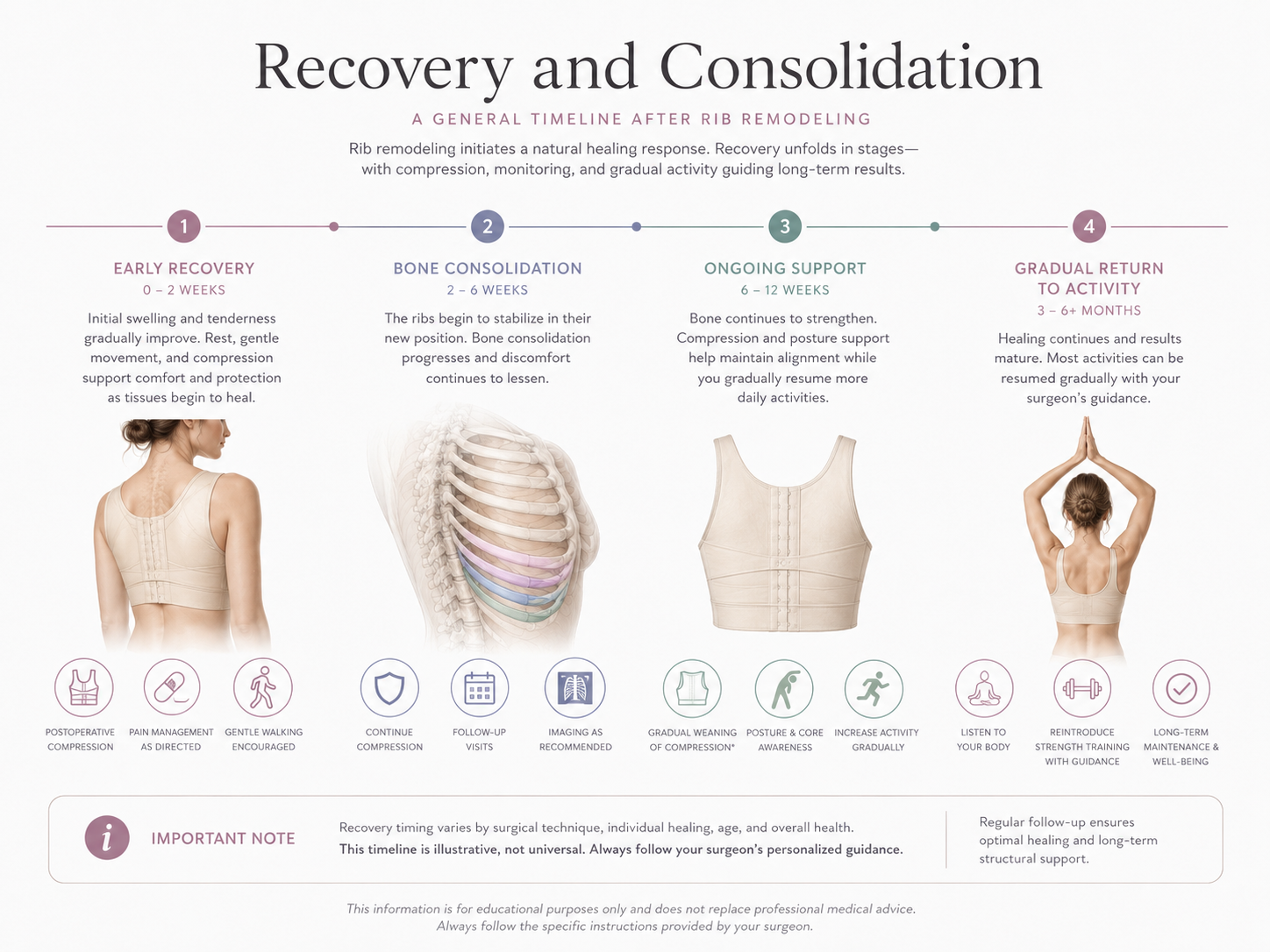
Rib remodeling may be performed through limited access, but bone healing remains a significant biological event.
Depending on the technique, patients may require structured external compression for several weeks or months.
Corsets, belts, foam systems and compression garments may be used to support the intended rib position during consolidation.
Poor adherence may contribute to asymmetry or loss of correction. Excessive or incorrectly applied compression can produce pain, skin injuries, pressure ulcers and respiratory discomfort.
Postoperative compression must therefore be treated as a medical device and monitored by the surgical team. It should not be managed as an improvised waist-training program.
Patients should also understand that sleeping, turning in bed, coughing, breathing deeply and returning to exercise may be uncomfortable during the initial recovery.
| CLINICAL PERSPECTIVE My personal clinical experience now includes more than 80 rib remodeling procedures. |
As a plastic surgeon focused on advanced body contouring, I consider rib remodeling one of the most important developments in structural body surgery in recent years.
This experience has reinforced my belief that the operation can create a significant improvement when skeletal anatomy genuinely limits waist definition.
It has also reinforced the importance of precise indication, controlled instrument trajectory, appropriate imaging, surgical planning, postoperative compression and close follow-up.
Rib remodeling should never begin with the question:
“How narrow can the waist become?”
The correct questions are:
In many patients, high-definition liposuction, rectus-diastasis correction, abdominoplasty, skin-tightening technologies or strategic fat grafting will be sufficient.
Rib remodeling should be considered when the skeletal framework remains the principal limiting factor after a complete anatomical assessment.
It must also be performed in an appropriately equipped surgical environment, with qualified anesthesia, proper imaging when indicated and immediate access to emergency resources.
A surgeon performing costal remodeling must be capable not only of completing the planned osteotomy, but also of identifying and treating thoracic complications.
| ESSENTIAL PRINCIPLE Small scars do not eliminate the need for major-surgery standards. |
RealSelf’s identification of rib remodeling as one of the defining aesthetic topics of 2026 reflects a genuine change in patient interest.
However, the future of the procedure will not be determined by online visibility.
It will depend on the quality of patient selection, the standardization of training, the evolution of safer instrument trajectories, the appropriate use of ultrasound and the willingness of surgeons to report both successful outcomes and complications.
The contributions of Russia and South America have been decisive.
Russian experience helped establish the principle of rib-preserving skeletal remodeling. Surgeons from Peru, Ecuador and Colombia developed distinct systems involving percutaneous access, ultrasound, piezoelectric instruments, parallel trajectories and internal fixation.
Brazil is now adding its own growing experience to this international movement.
Rib remodeling represents an important conceptual advance: the recognition that body contour is created not only by skin, fat and muscle, but also by the underlying skeleton.
Yet innovation must always remain subordinate to clinical judgment.
Rib remodeling should not be advertised as an easy shortcut to an exaggerated waist. It is structural surgery performed close to vital anatomy and should be reserved for carefully selected patients treated by properly trained surgeons.
When approached responsibly, it can become an established component of advanced body contouring.
The transition from trend to surgical discipline will depend on whether the surgical community treats the procedure with the seriousness its anatomy demands.
About the Author
Brazilian board-certified plastic surgeon with more than 15 years of experience and over 7,000 surgical procedures performed. His practice is focused on advanced body contouring, high-definition liposculpture, lipoabdominoplasty, breast surgery and structural approaches to body-shape optimization. His clinical experience includes more than 80 rib remodeling procedures. |

World-Class Aesthetic Surgery
& Longevity Centre
in Bali's Luxury Destination.